
(1) Behind the Mask: Vernacular Culture in the Time of COVID offers a profound reminder that the pandemic was not merely a medical or logistical crisis but also a deeply cultural one. The book underscores how communities adapted, coped, and ultimately persevered through vernacular creativity and collective resilience in a social way. (2) Anna Morcom’s Illicit Worlds of Indian Dance: Culture of Exclusions (2014) explores the profound cultural shifts that occurred with the advent of British colonialism in India, particularly, focusing on the hereditary female dancers—once the most esteemed artists in precolonial India. With the onset of
colonization, their status shifted drastically.
Asian Americans
Lament
The first prahara is spent in ploughing,
The second in harrowing.
Then you strike me with a stick—
Have you forgotten your Lord,
Oh dear farmer?
I owe you nothing at all,
I graze on the wild grass!…
Feeding the Ancestors:
Śrāddha is a Hindu calendrical ritual involving the offering of food to one’s ancestors. In this article, I trace the adaptation and diffusion of this ancient ritual in the context of diasporic and generational shifts. My paternal aunt, Shanta Nimbark-Sacharoff, described the migration from her small Indian village to New York, in the 1960s, where, together with her beloved elder brother, she discovered a newfound fascination with her family’s traditional foodways. Particularly, since her brother’s sudden passing, she has revived the annual observance of śrāddha, during which she always prepares “okra bhaji” to propitiate his soul.
Apoorva Sonavani
My name is Apoorva Sonavani. I was born in central India. I am a watercolor artist, a percussion enthusiast, and a Kathak dancer. Kathak is a classical dance form from India. In my childhood, my parents enrolled me in a dance and music class for creating a treasure to...
Downstate
In Chinese, there is a phrase, (chi ku). It means “to eat bitterness,” to endure hardship, to carry on, to persevere. My great-grandparents, Kao Tsao-Yuan and Loh Mei-Chun fled Shanghai for Hong Kong in 1949, before settling in the Bronx in 1960. They crossed through Ellis Island amid intense immigration restrictions from Asian countries. Leaving Shanghai was their bitterness to eat, as was navigating a new country.
Foodways
Northern New York’s Tug Hill is a little shorter than the Himalayas, to say the least. Not far from the foot of that plateau, however, at the edge of downtown Watertown, New York, I was fortunate to sit down recently with Prabin and Saranga Bhat of B-Hat’s Curry House for a lovely visit, sharing some of their favorite Nepalese flavors.
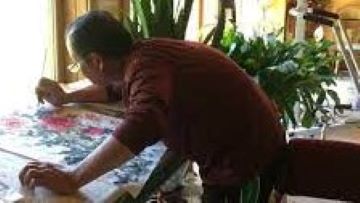
Artist Spotlight: Zhong-Hua Lu
Zhong-hua Lu, who was born in 1958, learned Chinese brush painting from his father and five uncles in Shandong Province, China, beginning at age five. Currently, he has taught traditional Chinese Arts, including Tai Chi and Chinese brush painting, at Mass MOCA,...
From the Killing Fields; Art and Healing in Asian America
A self-reflective essay on the use of folk art and performance to heal after conflict.