As a statewide organization, New York
Folklore is always looking to strengthen
our reach to diverse regions of the state. A
grant from the National Endowment for
t he Arts is helping us do just that! New
York Folklore is prioritizing fieldwork. We
are developing a network of community
scholars who will document traditional
arts throughout the state. These fieldworkers
are supported by New York Folklore
staff, headquartered in the Capital Region.
Our fieldworkers represent diverse
communities and levels of experience. We
are excited to welcome (or welcome back!)
this exceptional group of women to the
field: Divena Ramessar, Akilah Briggs Melvin, Nada Odeh, and Ladan Nikravan.
Public Folklore
From the Director
In addition to providing technical assistance
and professional development to folk artists
and folk cultural specialists, NYF supports
a robust schedule of exhibitions, arts workshops,
and concerts. Our “Ancient Arts in
New Contexts” program focused on documenting
and presenting the traditional arts of
India and Guyana.
Recognizing and Celebrating Schenectady’s Guyanese and Caribbean Heritages
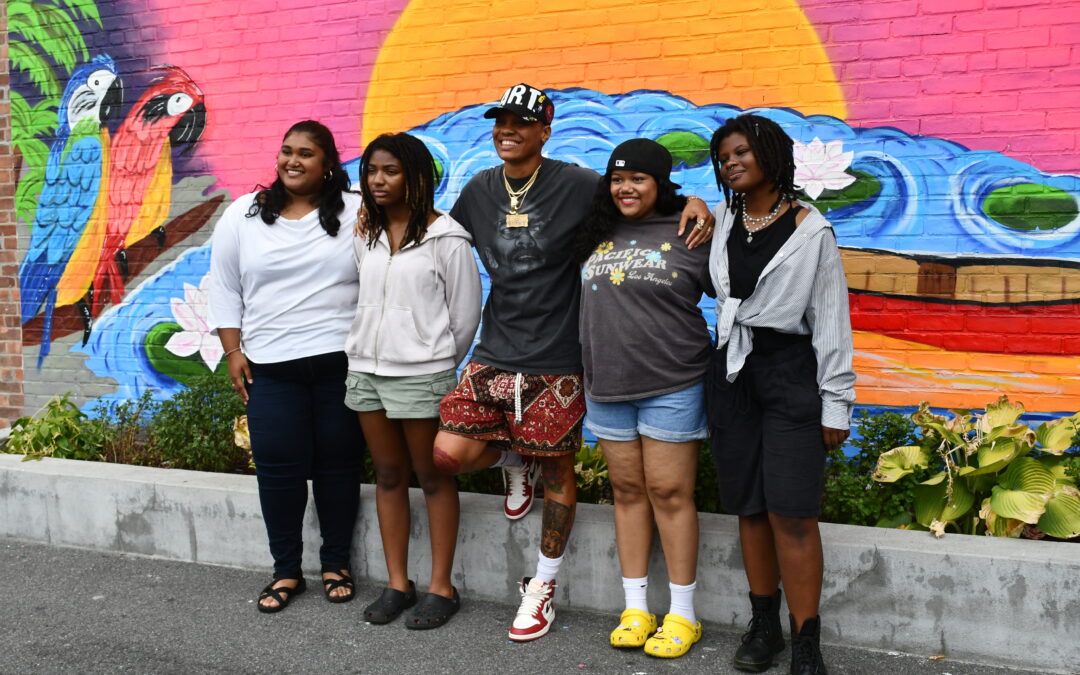
Today, I exited off the Michigan Avenue Exit ramp of Schenectady's I-890, and smiled. Looming in front of me was the mural that was created at the end of June 2024 by Raè Frasier of Art Money, three students enrolled in the Schenectady Job Training Agency's after...
Chicago Folklore Prize Winner:
On behalf of the New York Folklore Society’s executive board and the editorial
board of Voices, I want to congratulate Faye McMahon for winning the American
Folklore Society’s 2008 Chicago Folklore Prize with her outstanding book Not Just Child’s Play: Emerging Tradition and the Lost Boys of Sudan, published by the University Press of Mississippi in 2007. It brings all of us great happiness to see Faye receive this richly deserved award….According to the American Folklore Society’s web site, the Chicago Folklore Prize, “awarded to the author of the best book-length work of folklore scholarship for the year, is the oldest international award recognizing excellence in folklore scholarship.”
From the Director
Our History. The New York Folklore Society was founded in 1944 by a group of folklorists, historians, writers, and enthusiasts—dreamers and visionaries emerging from the Great Depression. Sharing a vision for cultural democracy after World War II, they felt that it was essential to collect, save, and share the folk arts and cultural traditions of the many cultures that made up the urban and rural areas of the state, its historic regions, and the American literary traditions it inspired. The founders’ goal was to “plow back”: to give back traditional arts to the people who created and maintained them.
Upstate
We all know that time flies when we’re having
fun. As for me, I can scarcely believe that
thirty years have passed since the summer
of 1979, when Valerie Ingram and I, both
recent Cooperstown “folkies,” organized a
conference we called Getting the “Lore” Back
to the “Folk” for anyone interested in folklore,
particularly applied folklore, as it was called
in those days. It was the ’70s, and this was
a new field.
From the Director
As we look back
on our organization’s
sixty-fifth year,
I would like to thank
all of our supporters
on behalf of the entire
New York Folklore
Society family.
2009 was a year of
great upheaval and rethinking of the organization….Partnerships in
2009 … helped us to realize programming goals: Union College, the Albany Institute
for History and Art, the City of Schenectady,
and the Erie Canalway National Heritage
Corridor were invaluable in helping us to
continue to provide folklore and folk arts
programming
North by Northeast:
The Hudson Valley Quadricentennial
in 2009 spurred all kinds of
special celebrations in cities along the
Hudson River, from flotilla parades and
festivals to art fairs, music performances,
and exhibitions…For its part in the Quadricentennial celebrations,
the New York Folklore Society commemorated these still-thriving cultural
traditions with “North by Northeast: Baskets
and Beadwork from the Akwesasne
Mohawk and Tuscarora.”
Downstate
Fundraising
is about individuals and groups with
different resources collaborating around a
vision shared: a good and workable marriage,
like the simple tin cup I imagined picking
up in the forest. Funders are collaborators.
As Bob Dylan put it, “I’ll let you be in my
dreams, if I can be in yours.”
From the Director
Folklorists are uniquely positioned to lend
an important voice to the debates around
immigration and immigration reform. As
globalization brings the world together, folklore
works to draw attention to that which is
local, individual, and expressive. Throughout
the next decade, it will be important for
folklorists to continue to draw attention
to the field of folklore through alliances
with disciplines and organizations outside
of folklore, thus providing a folkloristic
perspective on contemporary life.
Annual Conference Roundup
The New York Folklore Society decided
to blend these traditions at the 2010
conference with a new element: student
presenters. In collaboration with New
York University’s Latino studies and Latin
American studies programs, we invited
graduate students to present their work
on the theme of Latino Folk Culture
and Expressive Traditions on Saturday,
November 20, at NYU.
From the Field
As part of my fieldwork in the region, I
have had the opportunity to meet several
members and artists of the Karen community.
In August 2021, I was invited to
the Wrist Tying Ceremony, which is held
annually in different cities of New York
State….The Mohawk Valley has a rich history
of beekeeping. Moses Quinby, an important
figure in beekeeping history, lived and
worked in the valley. Today, there are Mohawk
Valley beekeepers carrying on the
legacy….Downtown Rochester is undergoing
major changes, and Monroe County’s new
folklife program, Flower City Folk, is documenting
the process.
Mohawk Hudson Folklfe Festival
The 2021 Mohawk Hudson Folklife Festival is described, from planning to implementation.
Poetry of Everyday Life
Zeitlin presents the four “sisters” of public folklore: scholarship, fieldwork, activism, and artistry.
What We Bring: Storytelling, Theater, and the Traditional Arts
Accompanying the exhibition, “What We Bring: New Immigrant Gifts,” were several performances by New York City artists. This essay details the performances and their connection to the City Lore exhibition.