I grew up in a family that had parties for everything, from christenings to first communions, quinceañeras to weddings. A party was food, music and dance to celebrate milestones in life, except funerals.
But when mom sent me to dance classes to chaperon my older sister, I discovered dance with a purpose and movement that had other meanings, like telling a story of where the dancers came from. Those rhythms moved my soul; the sweat made me feel things I had never felt or even could express before. I felt alive and a part of something bigger than my family.
No longer introverted, I learned to grasp the vocabulary of folkloric dance. This is the language of connection. Dance saved my life. It gave me a way to express frustration or any emotion. My young life had no direction, no dreams, no goals up to that point. With the group Estampas Latinoamericanas, I learned to play the drum, using rhythms to speak and sing poetry with a group. It sounded like heaven. My feelings of self-worth began to take root.
Arriving in New York in my late teens I continued learning other dances, including African and Afro- Caribbean, Middle Eastern and Latin dances. Now I had a repertoire of different styles of dances. I also began to study the history of Cumbia as a dance form that was born in the Atlantic Coast of Colombia with the fusion of the three cultures that began to form one community: The Spaniards from Europe, the Africans slaves from Guinea, and the natives of the land Colombia. I remember learning in the USA that Cumbia was the national dance of my country: Colombia.
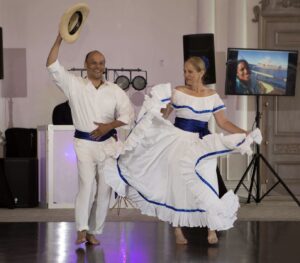
It was an amazing discovery that different parts of each culture formed Cumbia dance: the wide peasant skirt usually white (Spanish), the drums and rhythms (African) and some of the instruments of the music like the flute of millo (Natives of Colombia). Also, I learned that Latin dance steps are usually small because the slaves were shackled for a long trip to the Americas, as opposed to Ballroom dances like Waltz, European dances that use wide long steps that need lots of space to move. All these details showed me that my dance culture and Colombian and Latin culture are rich.
When I presented a dance project to a group of friends the feedback was so positive they wanted to learn “how to move that way.” This curiosity made me organize my thoughts to put together a class for them and when I did they were surprised by how simple, easy to follow and positive my instructions were that they encouraged me to teach dance as a way of living. So I began teaching groups at a community college in Hudson, NY. In 2002 I began teaching at other colleges, high schools and elementary schools in the Capital District as well as East Chester, Valhalla, NY.
The positive feeling of connection that I form with a group through teaching dance and the process of learning I see happening for people fills my heart. Sharing this way of communication with people while partner dancing is beautiful to watch. We all seek connection: Kids love the playfulness of working in pairs, adults learn to explore other ways of communicating.
It’s my hope students learn to move to the Cumbia and Latin rhythms knowing the historic journey of my culture. And it will be great to learn students’ views on those dances.
You can reach Carlos by calling 845-417-8682 or by email at learn2dancecumbia@gmail.com